20260828-LIBER-Trondheim
by Andy Corrigan
The Power of Libraries in an Uncertain World
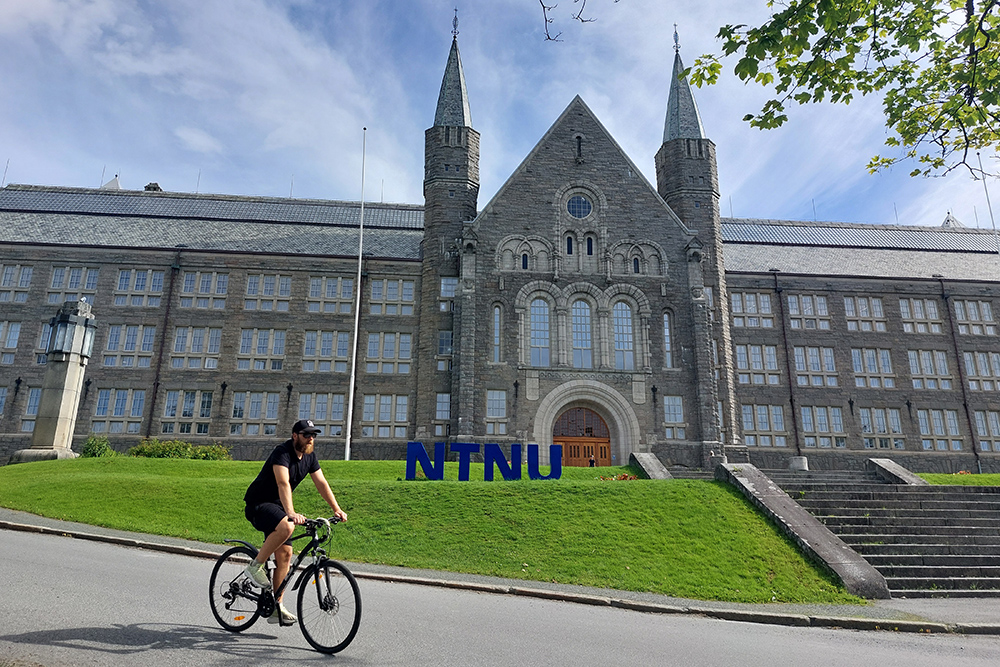
Opening a conference about research libraries with a keynote from the Director a national defence research institution might seem alarming, but the reality is that the library sector is inextricably a part of ‘… an uncertain world’. It was a sobering but bold, justified and thought-provoking way to set the tone for the LIBER 2026 Annual Conference in Trondheim, which took place between 1-3 July.
You can see LIBER’s article for their Highlights, but here are some of mine!
Keynote 1: ‘The Future of Open Science in a World with an Increasing Conflict Level’
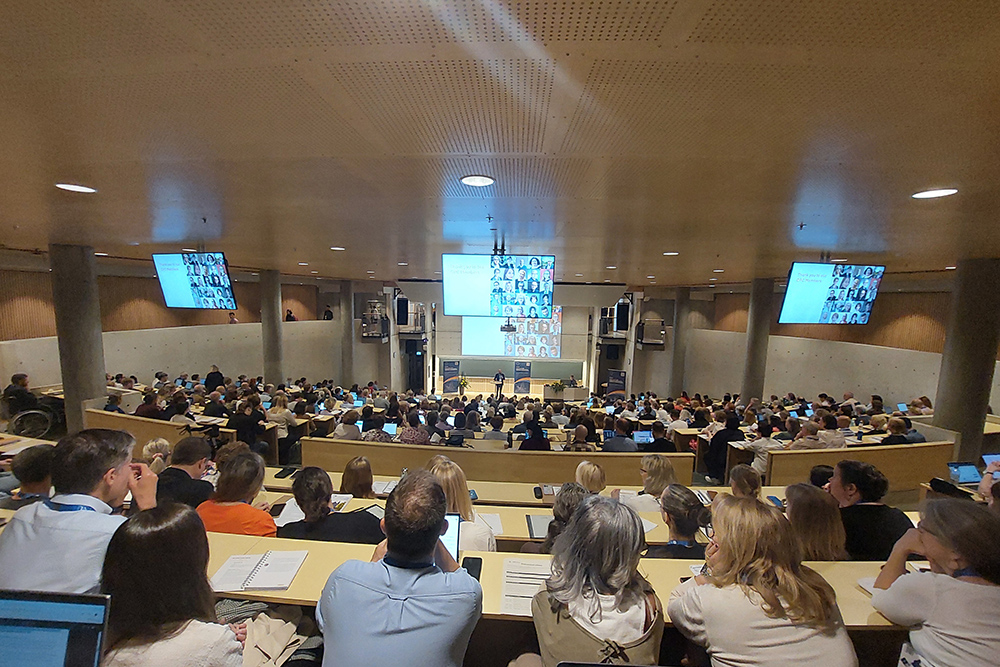
It is reassuring to know that there are people such as Kenneth Ruud, the Director General of the Norwegian Defence Research Establishment, who are taking the relationship between information technology and conflict/security seriously. He showcased how, in current increasing conflict levels, information and knowledge are more of a weaponised battleground than ever before. Only a few years ago “openness” felt like a moral option, but Ruud firmly defines it as fundamental to the defence of truth, trust, and our security – believing that ‘we must think about our research in the perspective of conflict.’ He also stressed that this conflict extends beyond STEM disciplines and is equally as relevant to the humanities and social sciences.
Hinting towards solutions, I particularly related to the way that he talked about how the homogeneity of AI can be fought back against through being unique, which whilst a harder approach, can be a more valuable one, and particularly so to a defensive stance. In answering a question about the Open Science ecosystem, Ruud shared an example of how one of the most cited articles in his field, written in the 1960s, wasn’t cited until computers came along in 1995. This alludes to another factor that is becoming synonymous with the fast-pace of the age in which we find ourselves – one of attention.
Session 2: AI and Library Service Development
I’m not the most enthusiastic adopter of AI, not yet at least, but it’s impossible to ignore in the context of this uncertain world. The three presentations in Parallel Session 2 explored different aspects of how AI is impacting the development of library services.
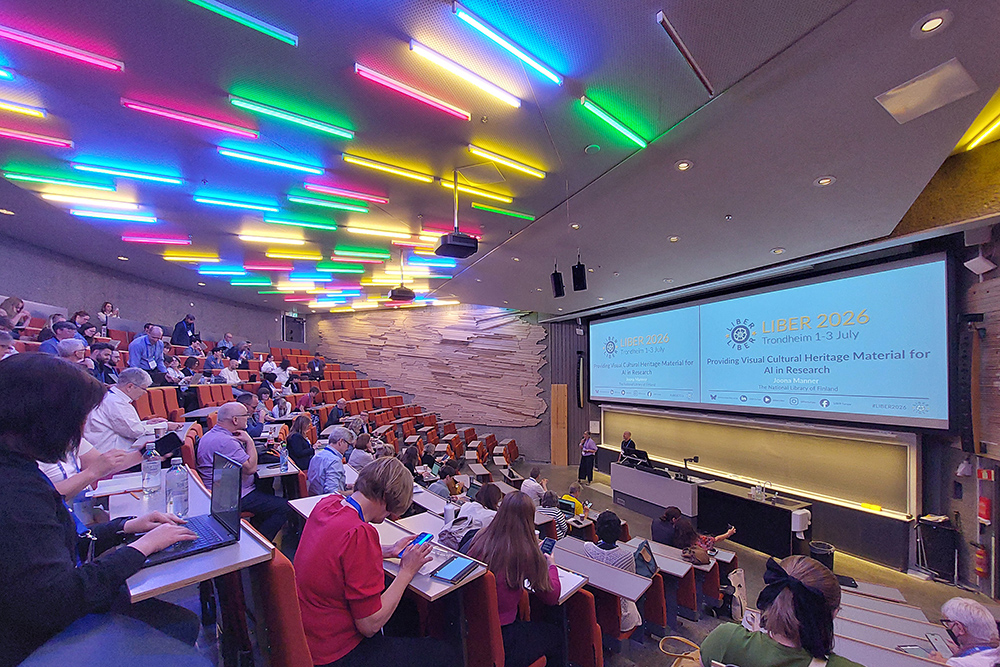
Joona Manner from the National Library of Finland talked about how the Finna Image and Metadata Download Tool is ‘Providing Visual Cultural Heritage Material for AI in Research’. They have built an extension to their search service, Finna.fi, that reaches across many Finnish collections and operates within the DARIAH infrastructure. The tool is currently testing how they can enable researchers to reliably download large image datasets by using AI to bypass the need for programming-orientated skills to use their API. This in turn means they can explore ways to connect to other AI image and text tools to experiment with automated image annotation and subject indexing. The concept is a great demonstration of how powerful open technologies can be when they are connected – it was great to see how IIIF fits into this puzzle as well!
We then heard about a library-led partnership between IE University in Spain and the Wageningen University & Research Library in the Netherlands that is exploring the use of Custom GPT’s through OpenAI’s educational licence. The aim is to ‘Strengthen Student Engagement with AI and Information Literacy’ by integrating generative AI with the structured scholarly data available through OpenAlex. The Ask-ademIA research assistant puts human agency and critical thinking centre stage through enabling user validated discovery. Whilst I have reservations about the nature of the OpenAI, the approach Cristina Huidiu and Alicia Gómez have taken represents a pragmatic and impactful solution that points towards more responsible and accurate use of AI, and is a testament to collaboration.
Finally, we heard about ‘Building AI Literacy in the Library World’ from Dagfinn Dybvig of NTNU, the host institution, who presented another collaborative project, called TAIKun, that is developing practical training resources for AI applications in library contexts across multiple Norwegian institutions. They’re taking a train-the-trainer approach to systematically increasing literacy and competency amongst their own staff, adopting a flexible and adaptable model that aims to stand the test of time and level-out uncertainty. While the project is a work in progress, their methodology and solutions offer not only hope, but tangible outputs we can all use as a model that maps questions and challenges to practical, real-world solutions – looking forward to seeing what appears at Biblioteksutvikling.no in 2027!
This session drew me in because it felt like a relatable intersection of the aspects of AI that I should better understand and some of the library services that are relevant to my own role – visual cultural heritage and information literacy. From the get-go, it’s starting to feel like the library sector is beginning to develop meaningful clarity amongst the fog of AI.
Nidaros Cathedral
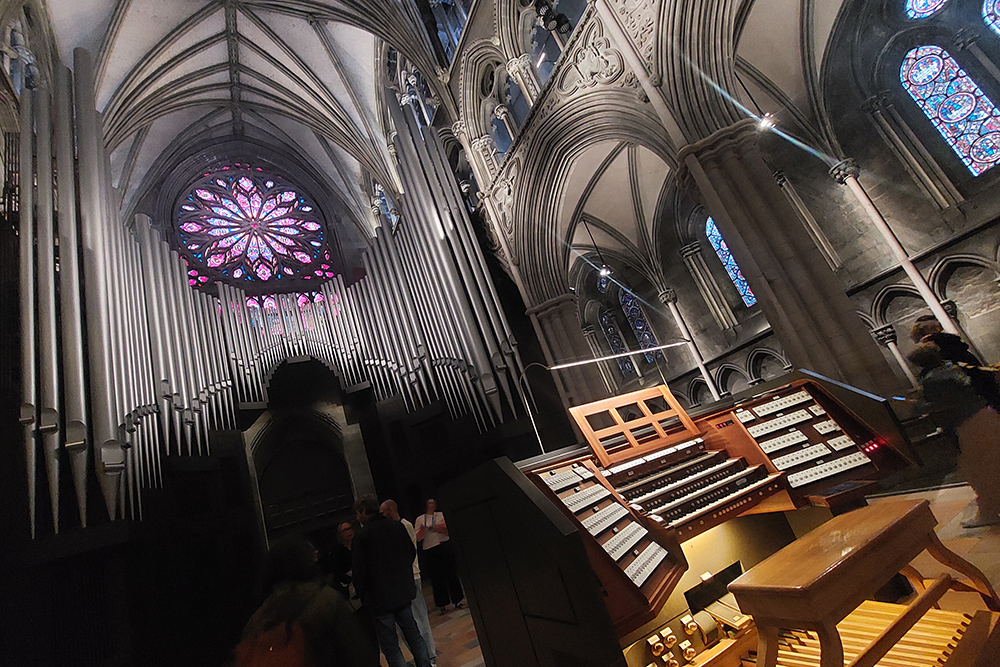
My role in the library is about demonstrating the positive aspects of digitised collections, the subtle and complex of which are part of a finely tuned balancing act with the things that we can lose in creating a sense of distance. When it comes to conferences there is no better parallel for me than the inherent social events, by which I mean they are as much a part of a programme as a keynote or parallel session. We can connect remotely in more ways than ever and there can be lots of benefits in doing so – financial and environmental impact are indeed compelling. In Trondheim, before the conference reception, we were treated to a private organ recital in Nidaros Cathedral. For me not only was this a privilege, but it was very much a part of the programme – a collective shared experience that speaks to ‘The Power of Libraries in an Uncertain World’.
Mobile phones have become a ubiquitous, synonymous even, part of experiencing any performance, so it will come as no surprise that many of the librarians in attendance reached for their phones to document witnessing this experience. While a recording is undoubtedly evidence, listening back can only remind us of the sensation of one of Europe’s biggest organs, pipes so big you could probably use them as slides, vibrating through our bodies. For the colleagues and loved ones we may share this evidence with, it is impossible to experience that, it remains very much a lived experience that was specific to those in attendance, becoming a collective memory as soon as the last note was played and the applause stopped. It was a profound way to remind us that physically attending a conference is an embodied way to create a resonating experience in every sense.
Session 8: AI and Collection Development
The second parallel session I attended was kicked off by An Smets from KU Leuven sharing ‘SubjectSeeker AI: No-code AI for Subject Matching Rare Books’. Having already used a custom AI model and experimented with ChatGPT, they were keen to move towards a platform-agnostic and no-code solution that made their work more efficient without over complicating it for a broad range of staff. KU Leuven currently has an institutional agreement with Copilot that keeps their inputs/outputs private from being used to further develop models by Microsoft. The results aren’t perfect, but the process of checking and correcting is now much quicker and more reliable as it can cross-check for any hallucination by using pre-defined subject lists. They are generously planning to share their prompt through Zenodo!
Talking about a work-flow closer to home for me, Megan Gooch from Bodleian Libraries, University of Oxford, reflected on ‘What is the Impact of AI on Digital Collections?’ as she talked about a research project there that’s been funded directly by OpenAI. While on the surface that might pose a potentially awkward relationship, it has been an opportunity for them to gain insight into how each operates and guided valuable conversations around the implications of AI. The specific nature of the project, which tried to better understand the extent of their regular collections that could be digitised and how, also meant the collaboration was focused on the scope of a very specific problem. The project demonstrated the importance for specialist library staff in an increasingly AI world, which is particularly encouraging.
In the last talk for this session, Alyssa Hyduk from University of Regina looked at ‘AI and Archives: Utilizing AI to Make Retroactive Finding Aid Conversion Simpler’. They’re challenge, with limited budget and staffing, has been to establish an archive database using AtoM, which requires inputs in specific formats (CSV or XML), using information from existing finding aids (in Word/PDF). Their solution uses Claude Cowork to run a python conversion script using a standardised prompt that also asks the archivist to resolve any issues before delivering an output. As with any other adventure into AI, the need for an expert human was clear, adding weight to questions like what happens if (when!) we run out of expertise? This project also reveals some other challenges – relying on token usage rather than institutional arrangements means that progress is really constrained, and any variation in the way input information is formatted requires adjustments.
Keynote 2: Patrick Weil
Patrick Weil’s reflections on ‘The Power of Libraries in an Uncertain World’ vigorously spoke to Kenneth Ruud’s earlier warnings about increasing levels of conflict in the world. Libraries Without Borders (Bibliothèques Sans Frontières), founded in 2007, is a global initiative that creates cultural and educational spaces for people affected by crises and precariousness. Their innovative Ideas Box can deliver a complete educational and cultural centre that enables the rebuilding of humanity, even in the most difficult contexts. Questioning who we are beyond the physical essentials of food and shelter, this mobile, connected, and energy self-sufficient multimedia centre creates an audience-tailored space containing a library, devices, creative equipment and a cinema for 50 people in only 20 minutes.
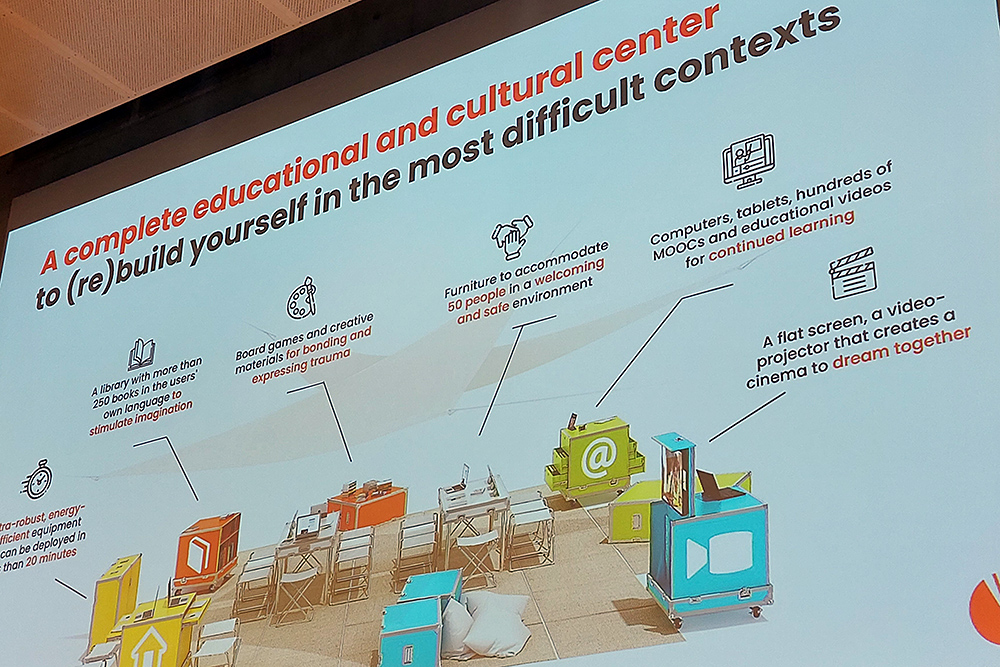
Just as active in many European countries as war-torn or natural disaster-hit ones, the initiative is a stark reminder that 40% of the world’s population still has little or no access to the internet, and that safe spaces are desperately needed everywhere. While nomadic digital library ‘Ideas Cubes’, and e-learning solutions on micro-SD cards create open-source digital learning hubs, Patrick points out that given a choice, people still always go straight to paper-based things first over the included digital solutions. This is a poignant reminder that paper is a democratic technology – to humanity, paper = freedom. As he powerfully spoke of libraries as agents of peace that are spaces in which knowledge can adapt, I was reminded of a research seminar I recently attended in Cambridge. In her talk, ‘Complicity in Universality: A deep dive into landscapes of peace knowledge in European integration archives’, Dr Cristina Blanco Sío-López talked about the importance of looking for, and exploring, the language of peace through the arts. Seeking peace might seem an antithesis to Rudd’s urgent call to think about research in the perspective of conflict, but Weil’s demonstrates how important it is that the two perspectives of war and peace can, and must, combine.
Workshop
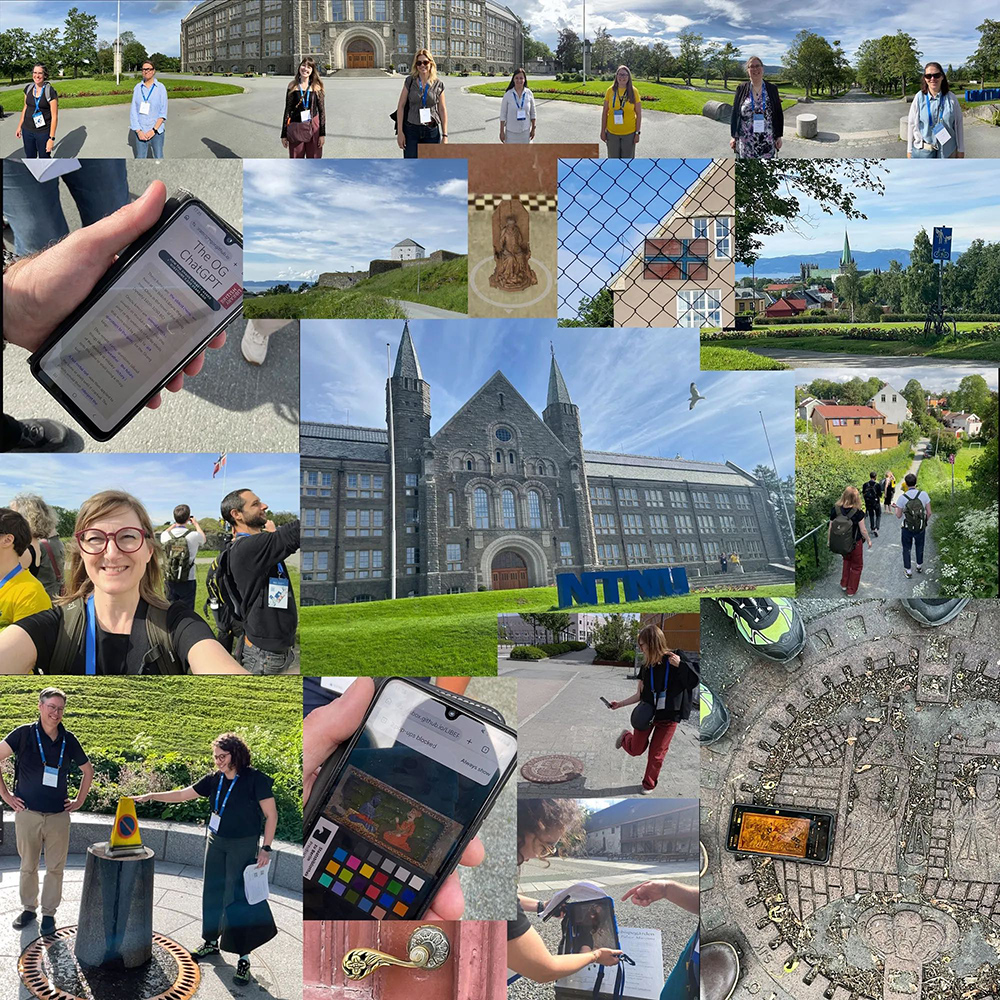
There were range of workshops, but as Co-Chair of the LIBER Digital Scholarship and Digital Cultural Heritage working group I was leading one of them! Our workshop, ‘Generative Humans: Mediating Automation & AI Through Impactful Engagement and Experience with Cultural Collections’, explored what the city of Trondheim could teach us about the power of libraries. I’ll be sharing and reflecting on the results of the workshop separately, but we shared a summary note in the August edition of the LIBER Insider.
Supported by enthusiastic local helpers, we split into three groups and explored the city whilst engaging with digitised collections in the real world using an interactive map of digital resources. Highlights included a carving of St Olaf that joined us in augmented reality, resituating historical photos of the city, re-united a medieval manuscript with Harold Hardrada’s burial site, putting ourselves centre stage in collaborative selfies, and even a sneak peek inside the NTNU University Library. This human centred approach tested the power librarians have in mediating cultural heritage in an age of AI and automation.
Session 15: Human Interfaces with Technology
Before I had to catch my flight home, I attended a third parallel session on the topic of ‘Human Interfaces with Technology’. Already a hackathon fan, it was great to hear from Ayla Karaman (Bodleian Libraries) and Roman Kuhn (Berlin State Library) about an initiative in which they’ve been using ‘Hackathons as Methodology: Advancing Collections as Data Through International Participation’. This international collaborative project sought to unpick how and why different user groups interact with digital collections data. Bound by common hackathon limitations such as the tendency of participants to select material or datasets that were easier in limited time, they can be somewhat a one-way street in terms of getting the results back into the data. But this project revealed some key insights into things they hadn’t anticipated, such as that users don’t really care about the boundaries inherent to collection datasets and their holding institutions. This, they concluded and I would strongly agree, really highlights the need to adopt approaches that favour reducing those boundaries.
Joseph Nockels has been ‘Mapping Stakeholder Tension in Automatic Text Recognition (ATR) Practice’ in response to the need for broader socio-technical understanding. Applying a theoretical ‘Trading Zone Modelling’ framework to the communities involved provided a understanding of how their interactions contribute to a collaborative process. The growing impact of the Hidden Ref and the Technician Commitment are testament to how the acknowledgment of labour is increasingly coming under the spotlight when it comes to research, and rightly so. The Contributor Role Taxonomy (CRediT) provides a way to articulate the complexity of such activity, so would be worth exploring further as acknowledgement is something that we’ve also been considering more deeply in our workflows and records. The focus of mapping this landscape is one of human labour, but I also wonder if there’s room for more nuance to how we consider labour. How might other factors of humanity fit into these models – the role and value of pedagogy or even pleasure for example?
The third talk also felt very close-to-home for me, especially in relation to the DSDCH working group workshop and much of the practice-research I’ve been exploring around hybrid dérive and psychogeography. Agnes Koreny (Metropolitan Ervin Szabó Library, Budapest) shared ‘From Local Memory to Research-Ready Knowledge’ – focusing on research integrity in practice-based community research. They took inspiration from Hungarian cinematographer Mihály Ráday, who co-ordinated an urban heritage documentation initiative centred around Király Street in Budapest during the 80’s. They wanted to see if a library could provide the infrastructure necessary to explore how this work could be continued in the present day, creating the ‘Houses on Király Street’ database in the Budapest Electronic Archive. This consists not only the outputs of a four-month study of the same street by volunteers in 2025, but all of the evidence that underpins that. Whilst a DSpace repository might not be the most engaging of interfaces for such an output, it does tick all the boxes for research integrity! [Note-to-self: get around to archiving a few things more rigorously!]. I’ve been invited to give a talk at this years ‘Focus on Open Science’ event in Budapest later this year, so I’ll have to go on a dérive of my own to see what I can find on the street!

Final thoughts…
What struck me over the entirety of this conference is that with an air of positivity we seem to be getting on top of the AI deluge. A couple of years ago, the library community seemed in a bit of a panic about it, but there’s now a calmer determination focussed on not only addressing the challenge, but in stepping-up to the important role of information …